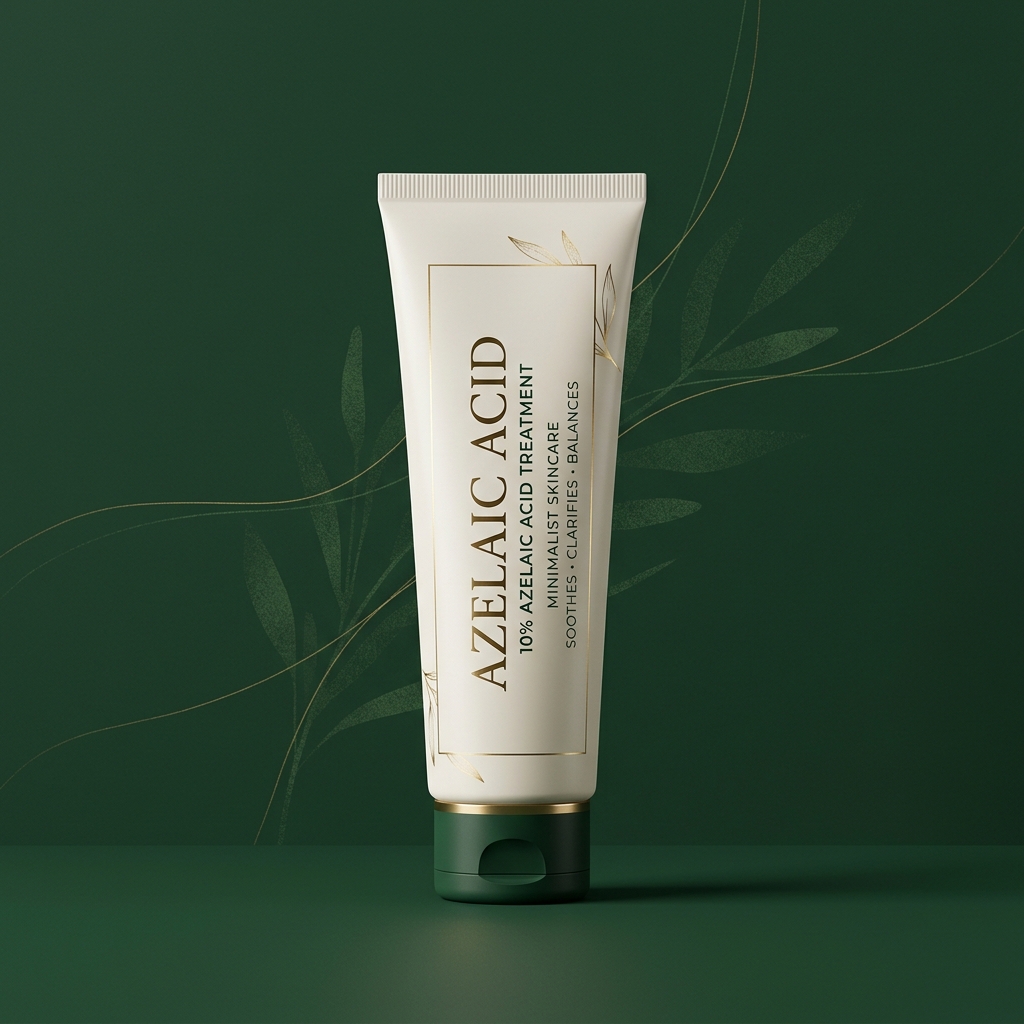
Walk into any conversation about skincare actives and you will hear the same names: retinol, vitamin C, niacinamide, salicylic acid. Azelaic acid rarely comes up.
That is strange, because it treats acne, rosacea, hyperpigmentation, and uneven texture — often simultaneously — with a side effect profile gentle enough that it is one of the few actives commonly recommended during pregnancy.
The reason it stays under the radar has more to do with marketing than efficacy. It is not new, not patentable in any exciting way, not photogenic in a bottle, and its results build quietly over months rather than producing a dramatic before-and-after.
This guide covers what azelaic acid actually does, who benefits most, how to use it, and where it fits against the actives you have probably already tried.
Key Takeaway
Azelaic acid is one of the few ingredients safe for all skin types, during pregnancy, and for sensitive skin — yet it treats acne, rosacea, AND pigmentation simultaneously. Most people who would benefit from it have never tried it.
What Azelaic Acid Actually Is
Azelaic acid is a naturally occurring dicarboxylic acid, found in grains such as barley, wheat, and rye. It is also produced by Malassezia, a yeast that lives on human skin as part of the normal skin flora.
The azelaic acid used in skincare is synthesized rather than extracted, which allows for consistent purity and concentration.
What makes it unusual among actives is the number of distinct mechanisms it operates through. Most ingredients do one thing well. Azelaic acid does four.
What to do
- Start with 10% concentration: Effective for most concerns with minimal irritation risk.
- Use it for multiple concerns at once: Tackles acne, redness, and dark spots simultaneously.
- Apply morning or evening: It's stable and photostable — no need to restrict to nighttime.
What to avoid
- Expecting overnight results: Pigmentation and rosacea require 8–12 weeks of consistent use.
- Layering with strong acids: Avoid applying directly with high-strength AHAs/BHAs in the same routine.
- Ignoring tingling: Mild tingling is normal but persistent stinging means too high a frequency.
How It Works: Four Mechanisms
1. Normalizes keratinization
Inside a pore, dead skin cells are meant to shed and clear. When that process goes wrong — a state called hyperkeratinization — cells accumulate, mix with sebum, and form the blockages that become comedones.
Azelaic acid helps regulate this process, reducing the formation of new blockages. This is the same broad mechanism retinoids use, though azelaic acid achieves it more gently.
2. Antibacterial activity
Azelaic acid has demonstrated activity against Cutibacterium acnes, the bacteria involved in inflammatory acne, and against Malassezia, the yeast implicated in seborrhoeic dermatitis and fungal acne.
That second point matters more than it sounds. Most acne treatments target bacteria but do nothing for fungal involvement — and fungal acne is frequently misdiagnosed and treated with products that make it worse.
3. Anti-inflammatory action
Azelaic acid reduces inflammatory markers and scavenges free radicals. This is why it is effective for rosacea, where inflammation rather than bacteria drives the visible symptoms.
It is also why azelaic acid tends to calm skin rather than aggravate it — an unusual property for an active ingredient.
4. Inhibits tyrosinase
Tyrosinase is the enzyme that initiates melanin production. Azelaic acid inhibits it, which is the mechanism behind its effect on hyperpigmentation.
A particularly useful detail: azelaic acid appears to act selectively on hyperactive melanocytes — the overproducing cells responsible for dark patches — rather than affecting normal pigment-producing cells uniformly. This is why it is generally considered unlikely to cause the unwanted lightening of surrounding skin that some other pigment-targeting ingredients can.
What It Treats
Acne
Azelaic acid addresses acne through three of its four mechanisms simultaneously — reducing blockages, targeting bacteria, and calming inflammation.
Where it particularly excels: acne accompanied by post-inflammatory marks, since it treats both the breakouts and the discolouration they leave behind. Most acne treatments do nothing for the second part.
Realistic expectation: it is generally slower than benzoyl peroxide or a prescription retinoid for moderate to severe acne. For mild to moderate acne, particularly in sensitive skin that cannot tolerate stronger options, it is a genuinely good choice.
Rosacea
This is one of azelaic acid’s strongest applications, and it is prescribed for rosacea in many markets specifically.
Its anti-inflammatory action addresses the papules and pustules of papulopustular rosacea, and it is generally better tolerated than most actives by rosacea-prone skin — which is notoriously reactive.
A caveat: it tends to help more with the bumps and inflammation than with persistent flushing or visible blood vessels, which often need different interventions.
Post-inflammatory hyperpigmentation
The marks left behind after a blemish heals — brown or reddish patches that can outlast the original spot by months — respond well to azelaic acid.
This makes it particularly relevant for deeper skin tones, where post-inflammatory hyperpigmentation is more common, more persistent, and frequently more distressing than the acne itself.
Melasma
Azelaic acid has research support for melasma, and it is one of the options most commonly suggested during pregnancy, when many pigment-targeting ingredients are avoided.
Being realistic: melasma is difficult to treat and prone to recurrence. Azelaic acid helps, but sun protection does more, and neither produces a permanent fix. Managing melasma is ongoing rather than curative.
Texture and general tone
Because it normalizes cell turnover, azelaic acid gradually improves surface texture and evens overall tone — a slower, subtler benefit than its targeted effects, but a real one.
Concentrations: What Actually Matters
| Concentration | Availability | Typically used for |
|---|---|---|
| 5-10% | Over the counter | Mild acne, pigmentation, texture, sensitive skin |
| 10% | Over the counter (common ceiling) | The standard OTC strength |
| 15% | Prescription in most markets | Rosacea |
| 20% | Prescription in most markets | Acne, more stubborn pigmentation |
Is 20% twice as good as 10%? Not proportionally. Prescription strengths work faster and are more effective for established rosacea and moderate acne, but 10% over the counter produces meaningful results with consistent use over a longer period.
A formulation note that matters more than the number: azelaic acid is poorly soluble, and how a product suspends and delivers it substantially affects both efficacy and texture. Some over-the-counter 10% formulations perform better than others at the same concentration purely because of formulation quality.
Who Benefits Most
Sensitive and reactive skin. Azelaic acid is one of the few genuinely effective actives that most sensitive skin tolerates. If retinoids and acids have consistently caused problems, this is the logical next thing to try.
Rosacea-prone skin. It addresses the inflammation directly and is unlikely to trigger flare-ups the way many actives do.
Anyone with acne plus pigmentation. Treating both concerns with one product is genuinely efficient, and few ingredients do it.
Deeper skin tones. Effective on post-inflammatory hyperpigmentation, gentle enough to avoid triggering further pigmentation through irritation — a real risk with harsher actives.
During pregnancy. Commonly recommended as one of the more suitable options, though as with anything during pregnancy, this warrants confirmation from your doctor rather than a blog post.
Anyone who cannot tolerate retinoids. It is not a direct equivalent, but it addresses several of the same concerns with considerably less irritation.
Who Might Skip It
If you already tolerate a retinoid well and your primary concern is aging rather than acne or pigmentation, a retinoid does more for collagen and fine lines. Azelaic acid does not meaningfully address wrinkles.
If you have severe or cystic acne, azelaic acid alone is unlikely to be sufficient. That warrants a dermatologist.
If you find the texture intolerable. Some formulations feel grainy or leave a residue. This is a genuine reason people abandon it, and it is worth trying a different formulation before writing off the ingredient.
If you need fast results for an event. This is not a quick-acting ingredient.
How to Use It
Starting out
Frequency: begin once daily, in the evening. Sensitive skin may prefer every other day for the first two weeks.
Amount: a pea-sized amount for the full face is sufficient. More does not accelerate results.
Application: apply to clean, dry skin, before moisturizer.
Sun protection: azelaic acid does not increase photosensitivity the way retinoids do, but sunscreen is essential regardless — particularly since you are likely treating pigmentation, which UV exposure actively worsens.
Where it fits in your routine
Morning: Cleanse → azelaic acid (optional) → moisturizer → sunscreen
Evening: Cleanse → azelaic acid → moisturizer
Azelaic acid can be used twice daily, and prescription formulations are often directed that way. Most people find once daily sufficient to start.
What to expect
Immediately: a mild tingling or warmth on application is common and usually settles within a few minutes. This typically diminishes over the first week or two as your skin adjusts.
Weeks 1-4: possible mild dryness or flaking. Some people experience a brief increase in breakouts as existing congestion surfaces, though this is less common and less pronounced than retinoid purging.
Weeks 4-8: inflammation reduces, redness calms, active breakouts decrease.
Weeks 8-16: pigmentation begins visibly fading. This is the slowest of its benefits, and the one that requires the most patience.
Beyond 4 months: continued gradual improvement in tone and texture with sustained use.
The most common reason people conclude azelaic acid does not work is stopping at week six, before the pigmentation benefits have had time to appear.
Layering With Other Actives
Azelaic acid is unusually compatible with other ingredients.
With niacinamide: an excellent pairing. Both address pigmentation and inflammation through different mechanisms, and niacinamide supports the barrier.
With vitamin C: compatible. Vitamin C in the morning, azelaic acid in the evening is a straightforward arrangement, though many people use both at the same time without issue.
With retinoids: these can be combined, and dermatologists sometimes prescribe them together. However, combining two actives increases irritation risk — alternating nights is a gentler approach, particularly when starting out.
With benzoyl peroxide: compatible, and sometimes used together for acne. Watch for cumulative dryness.
With exfoliating acids: possible but requires care. Azelaic acid is not a traditional exfoliant, but layering it with AHAs or BHAs can overwhelm the barrier. Separate them by day or time of day.
With hyaluronic acid and moisturizers: no conflict at all. These support tolerability.
Side Effects and How to Manage Them
Tingling or mild burning on application is the most commonly reported effect. It usually settles within minutes and diminishes over the first few weeks.
Dryness and flaking can occur early on. A good moisturizer applied afterward — or before, as a buffer — resolves this for most people.
Temporary redness is not unusual initially, particularly in sensitive skin.
When to reduce frequency or stop: persistent burning, worsening redness that does not settle, swelling, or any rash. These indicate irritation or reaction rather than adjustment.
Managing tolerability:
- Reduce to every other day and build back up
- Apply moisturizer first as a buffer, then azelaic acid, then moisturizer again
- Use a smaller amount
- Avoid layering it with other actives while adjusting
- Ensure skin is completely dry before applying
Azelaic Acid Compared to Other Actives
| Azelaic acid | Retinoid | Niacinamide | Salicylic acid | |
|---|---|---|---|---|
| Acne | Good | Very good | Moderate | Good |
| Rosacea | Very good | Often aggravates | Moderate | Variable |
| Pigmentation | Very good | Good | Moderate | Minimal |
| Fine lines | Minimal | Very good | Minimal | Minimal |
| Texture | Good | Very good | Minimal | Good |
| Irritation risk | Low | Moderate to high | Very low | Moderate |
| Pregnancy | Commonly suitable | Avoided | Commonly suitable | Low concentrations only |
| Speed of results | Slow | Slow | Slow | Moderate |
The honest summary: retinoids remain more effective for aging and, for many people, for acne. Azelaic acid wins clearly on rosacea, on tolerability, and on treating acne and pigmentation simultaneously.
Why It Stays Underrated
Understanding this helps explain why an effective ingredient gets so little attention.
It is not new. Azelaic acid has been used dermatologically for decades. Skincare marketing runs on novelty, and there is nothing novel to say about it.
Results are gradual. It does not produce the dramatic short-term visible change that drives social media content.
The texture is often unremarkable. Many formulations are thick, slightly grainy, and leave a residue. This is a genuine product experience issue, not just perception.
It has no compelling origin story. “Synthesized dicarboxylic acid found in grains” does not market as well as a rare botanical or a patented complex.
It is often prescription-associated. In markets where the effective concentrations require a prescription, it sits outside the consumer skincare conversation entirely.
None of these are reasons it does not work. They are reasons you have not heard about it.
Choosing an Azelaic Acid Product
Because formulation quality varies more than with most actives, a few things are worth checking.
Check the concentration is stated. Products that mention azelaic acid prominently without disclosing a percentage often contain very little. Brands confident in their formulation usually state it.
Look at where it sits in the ingredient list. At a genuine 10% concentration, azelaic acid should appear near the top — typically within the first three or four ingredients. If it appears after the preservatives, the amount is negligible.
Consider the base texture. This is the most common reason people abandon azelaic acid. Formulations vary considerably:
- Gel and cream formulations are the traditional format. Effective but can feel thick or slightly grainy, and may leave a visible residue under makeup.
- Suspension formulations distribute the acid in a lighter base. These tend to feel more comfortable but can pill under other products.
- Serum-style formulations at lower concentrations are the lightest option, though generally less potent.
If your first attempt felt unpleasant, trying a different format before abandoning the ingredient is worthwhile. The texture problem is a formulation issue, not an inherent property of azelaic acid.
Check what else is in the formula. Some products pair azelaic acid with niacinamide or soothing ingredients, which can improve both efficacy and tolerability. Others include fragrance or high alcohol content, which undermines the point of choosing a gentle active.
Consider prescription if over the counter is not working. If you have used a 10% formulation consistently for four months with limited results — particularly for rosacea — a dermatologist can prescribe 15% or 20%. That is a meaningful step up rather than a marginal one.
Do not assume price predicts quality. Azelaic acid is inexpensive to produce. What you are paying for in premium formulations is texture and supporting ingredients, not a better version of the active itself.
Frequently Asked Questions
What does azelaic acid do? It normalizes cell turnover in pores, reduces acne-causing bacteria and Malassezia yeast, calms inflammation, and inhibits melanin production. This combination makes it effective for acne, rosacea, hyperpigmentation, and uneven texture.
Is azelaic acid better than niacinamide? They address overlapping concerns differently. Azelaic acid is more effective for acne and pigmentation; niacinamide is gentler and better for barrier support and oil regulation. Many people use both.
How long does azelaic acid take to work? Inflammation and breakouts often improve within four to eight weeks. Pigmentation typically takes eight to sixteen weeks. Stopping before twelve weeks is the most common reason people conclude it is ineffective.
Does azelaic acid cause purging? Some people experience a mild initial increase in breakouts as existing congestion surfaces, though it is generally less pronounced than retinoid purging. It typically resolves within four to six weeks.
Can I use azelaic acid with retinol? Yes, and they are sometimes prescribed together. However, combining two actives increases irritation risk. Alternating nights is a gentler approach, particularly when starting out.
Is 10% azelaic acid strong enough? For mild acne, pigmentation, and texture, yes — with consistent use over several months. Prescription strengths of 15-20% work faster and are more effective for established rosacea and moderate acne.
Is azelaic acid safe during pregnancy? It is commonly listed among the more suitable options during pregnancy, but this should be confirmed with your obstetrician or dermatologist rather than decided from an article.
Does azelaic acid make skin sensitive to sunlight? It does not increase photosensitivity the way retinoids do. Daily sunscreen is still essential, especially since UV exposure actively worsens the pigmentation you are likely treating.
Why does my azelaic acid sting? Mild tingling on application is common and typically settles within minutes, diminishing over the first few weeks. Persistent burning indicates irritation rather than adjustment — reduce frequency or buffer with moisturizer.
Can azelaic acid be used on the body? Yes. It is sometimes used for body acne and back acne, though larger areas require more product and coverage can become impractical.
The Bottom Line
Azelaic acid is one of the most useful ingredients in skincare and one of the least discussed. It treats acne, rosacea, post-inflammatory hyperpigmentation, and texture through four distinct mechanisms, with a tolerability profile that most sensitive skin handles well.
Consider it if you:
- Have acne accompanied by dark marks
- Have rosacea, or redness-prone reactive skin
- Cannot tolerate retinoids or exfoliating acids
- Are pregnant and looking for a suitable option, after confirming with your doctor
- Have deeper skin tone and want to address pigmentation without risking irritation-induced darkening
Skip it if you:
- Already tolerate a retinoid well and your main concern is aging
- Have severe or cystic acne, which needs medical treatment
- Need visible results quickly
And the single most important thing to know: give it at least twelve weeks. The pigmentation benefits — arguably its strongest advantage — do not appear early. Most people who conclude azelaic acid did nothing for them stopped before it had a chance to.
This article is for informational purposes only and does not constitute medical advice. Azelaic acid at prescription strengths requires medical supervision. If you have rosacea, persistent acne, or are pregnant, consult a board-certified dermatologist or your doctor before starting any new active ingredient.
This article is for informational purposes only and does not constitute medical advice. Azelaic acid at prescription strengths requires medical supervision. If you have rosacea, persistent acne, or are pregnant, consult a board-certified dermatologist or your doctor before starting any new active ingredient.
Was this article helpful?

Anam Ahsan
Founder & Editor-in-ChiefI started Glam Rock Web because I was tired of beauty content that read like advertising. Everything published here is researched, tested where possible, and written to be useful — not to sell you something.



Comments (24)
Hannah W.
2 days agoThis guide saved me so much money — went with the budget pick and honestly can't tell the difference from serums twice the price!
Anam Ahsan Author
1 day agoSo glad it worked out for you, Hannah! That's exactly the kind of result we hoped readers would see.